zka: (Default)
I want to start this entry on a positive note! (Before I describe our first 2 weeks of confusion and overwhelm.) Last night we discovered the best Indian food ever, a 3-minute walk from our house. Today we rode our bikes to the mall, and had lunch with expat friends (ex-Portlanders), it was lovely.

So it's been a nice 24 hours!


I've heard folks describe the Netherlands as relaxed, and laid back! I'm sure it's true, after you spend significant time here. Long enough to find your groove.

I'm fully confused by everything here, on an hourly basis. I expected to escape the layer cake of stress, 2 weeks ago. Instead I have moments where I feel like my breathing is constricted and rapid. Holy shit dude. Every single email, phone call, interaction, and transaction (no matter how minor) has a language barrier, because we don't speak Dutch.

I like the Dutch language. It's a close relative to English. It should be "easy" to learn, compared to (oh I don't know) Mandarin? I'm watching videos and raiding the Hear Dutch Here website. It's been 2 weeks, I can say "good day" and "thank you". I'm unsure if my context is correct; am I being polite, or inappropriate?

I feel like there's a 3x difficulty multiplier to all things digital. I keep a Google Translate tab open, and I'm constantly pasting text into it. Sometimes the translations are suspect! "Alstublieft" is translated as "please", but workers say this to me after I say "thank you"?? As always, context is everything: This expression is a formality, and the literal translation is akin to "as it pleases you".

Spoken Dutch has sounds which aren't present in spoken English. The letter G sounds like clearing your throat, "hhccchhhhh". Watch out, this sound has regional variations, too.

By the way. Everything is digital now. The black glass controls reality: Buying stuff, finding information, making plans, sourcing food, the financial universe. It's all pixels through a language barrier.

Lots of websites just don't work here. I ordered specialty sewing thread from a German website (couldn't find a store in the Netherlands). Clicked the checkout button, it debited my account ... but the order wasn't confirmed, and the items were still in the cart? Hmmmm. I called them by phone (note the 9x language multiplier: my English × Dutch bank × German store employee), she was very nice and it's resolved now, but this sort of thing happens alarmingly often. My husband had a package tied up in Dutch UPS for 3 days, and of course the phone tree is useless, even after you understand which options are available.

Very frustrating, when you're trying to (oh I don't know) do anything. Or buy essential objects for your empty living space.

There's a local bakery whose website simply reads: "This account has been suspended. Either the domain has been overused, or the reseller ran out of resources."

In America, I think we're raised with the implicit expectation that things mostly just work, at predictable times. If something is obviously broken, we feel entitled to have someone else fix it. I suspect the rest of the world is a bit loosey-goosey.


Getting insurance is straightforward. Getting a doctor is trickier. Your GP (General Practitioner) must work in your zip code?! This seems weird, but our expat friends explained it's because doctors make house calls, and they don't want to travel far from the clinic.

Husband called all the eligible medical practices, and no one was accepting new patients. On the final call, he stated that everyone else had turned us away, and they sighed and said "okay" and squeezed us into their practice ... starting in October.

If you take life-saving medication, I hope you have several months squirreled away in reserve?

Also new to me: Doctor's appointments are strictly 15 minutes long, and you're allowed to discuss one issue. If you have multiple issues, you need to schedule multiple 15-minute appointments (yes, these can be adjacent).


Trash must be sorted correctly. There are 14 categories of household waste, but only 4 are relevant to us:

  • Paper and cardboard: goes in the blue bin.

  • Compost, food scraps: in the green bin.

  • Plastic, metal, drink boxes: in the grey bin.

  • Everything else ("Restafval"): Put it in a bag, walk it up the street, open the weird public receptacle with a city-issued key fob, stuff the bag into its chute. The bag falls to a subterranean pit. When the pit is full, a sensor is tripped, and the city picks up the trash.


But wait! Our grey bin is marked "Restafval", hmmmmm. We called city hall, and the representative didn't understand why we had a can for "everything else". They promised to launch an investigation! Which probably didn't happen. We're still awaiting their callback, days later.

Foolishly, we've dumped all our trash in the grey bin, because we're Americans, duh. Tomorrow, we have the exquisite privilege of sorting 2 weeks of rancid garbage into proper bins and bags, and I'm living honey


Our dog loves the backyard. She's barking at everything: cats, neighbors, doors slamming shut. Houses are packed closer here, we share walls with neighbors. Baby girl please stop I'm mortified


Everything is tiny, and proportioned strangely, not really the human-scale I expect: refrigerator, shower, washing machine. The "oven" is a microwave with special modes that mimic baking and grilling.

Don't get me started on the murder-stairs.


That's enough complaining for one night. I guess the punch line is: it's been a mere 2 weeks, and we're still """adjusting""". Imagine a progress bar, ranging from "American" to "Dutch"; we're at about 2%, and it's no one's fault but ours, of course.

Foolishly, I expected life would be easier here. Currently, it's not! I'm inventing new ways to cope with stress, and being immersed in situations which are (literally) foreign to me.

Unless you're moving into a fully furnished house, and already speak the language: there will be many challenges. How's that for mind-blowing wisdom? Wow, great.

Next entry: be more positive, yes? There's been delights and surprises in the mix too, so ... to be continued.
zka: (Default)
I've written about obvious hurdles to immigration: legal, jurisdictional, logistical. The more I chat with folks who dream about moving to a different country, I realize that no one is acknowledging the psychological barriers to leaving.

Most people have created lives for themselves which are comfortable, or at least familiar. We invest time, money, and energy to create spaces that we (hopefully) enjoy occupying. It's hard to walk away from a good life, even if you wake up one day and realize you're surrounded by bad actors; a nest of evil. In this case, wouldn't you cling harder to the good things in your life, and be more reluctant to move on?

The Spectrum of Not-Leaving


Starting in 2025, in almost every conversation, I asked people how they felt about leaving the country. Were they open to the idea? Did they have a plan, maybe relatives overseas? Did they have an exit strategy?

This isn't a scientific ranking, but in my head it's convenient to sort people's answers into 4 buckets:

  1. Doesn't plan to leave.
    "I'm not leaving."
    Includes folks inventing social proof: "No one I know is thinking about leaving."

  2. Wishes to leave; believes there's not enough resources.
    "It's too expensive." "I'm barely making ends meet now." "I don't know how to do it."

  3. Wishes to leave; defers responsibility with commitments.
    "I own a successful business here." "I have a 15-year-old." "I have such a strong friend group here."

  4. Actively trying to leave.
    "I just learned that {{Country}} will pay you to relocate there, if you have certain skills. So I visited their immigration website, and it looks like I could really do this ..."


Frequently people daydream about leaving, while simultaneously feeling stuck: "I can't leave, because ____" or "it won't happen, because ____". People's brains frame the big move in disqualifying terms.

I think the harsh truth is, there will always be a reason to not do it. If you feel blocked by one obstacle, and that obstacle magically disappeared overnight: your brain would fill that void with another obstacle, and you would still feel blocked.

This is a perfectly human response to difficult decisions, and overwhelming amounts of stress. This does not suggest that you're "weak" or "ineffective", or whatever maladaptive buzzwords that capitalism and hustle culture have programmed into us. This shit is hard to contemplate. There is no painless way to teleport your whole life to a different locale. You already know that some things will be lost along the way.

Losing my possessions, and comfy routines, felt like a personal attack to me. It's irrational, but that was the overwhelming feeling I dealt with. The demand to forfeit my favorite things, places, foods, and easy access to people; it made me defensive and angry, on top of the maelstrom of emotions surrounding the moving process itself.

Things will be lost, in a literal sense. Some things, and connections, will probably be left behind forever.

The Purge


When I moved to Portland (circa 2002), all my worldly possessions fit inside a 4-door Ford Granada. 8 rentals and 2 home purchases later, I felt embarrassed when my husband and I rented an industrial dumpster to dispose of stuff (furniture, clothes, "art", etc), and we filled the dumpster to capacity. We ran out of room, in a big-ass dumpster. That's how much crap we were dragging around.

Then we moved to house #3 (Portland, again). It took one-and-a-half moving trucks to move our empire of junk. It was bizarre, realizing that our collection of things had somehow expanded further. (This is after filling that dumpster, mind you.) I felt like something was deeply wrong with this scenario, like a disease of "stuff" had infected our life.

Fast-forward to 2025, we're talking about a big move, and there's an urgent need to dispose of everything. What happens to all this crap?? We brought an estate sale executor to the house, and showed her our piles of possessions, room by room. Afterwards, she sat us down and delivered the verdict:

"Boys, you don't have enough valuable stuff to make an estate sale worthwhile."

BOYS

I HAVE SEEN YOUR STUFF, AND IT'S NOT EVEN THAT GOOD

It turns out that the best estate sales occur after a house is occupied for decades. (How many moving trucks is that?? I get dizzy comtemplating this.)

She proposed another plan: her crew could do a total cleanout, and keep everything (meaning: our stuff would be sold in an actual estate sale elsewhere, to recover the cleanout expense). Instead of charging us, she would pay us $400. Obviously the money is a pittance; if we had infinite time, we could eBay everything for a few thousand bucks, but we don't have time, do we? So this seemed like the best option.

One twist is that she photographed anything sale-worthy. Anything that wasn't photographed was still considered "ours", which is how some of my electronic "art" was gifted to Portland nerds. I'm happy it found good homes, but it's personally sad too: I spent/wasted so much time on these pieces; they broke; their LEDs burnt out; the whole hardware-hacking adventure didn't change the world like I imagined it would. It was a curious sidestep in my career, and now we've all moved on.

Say Goodbye


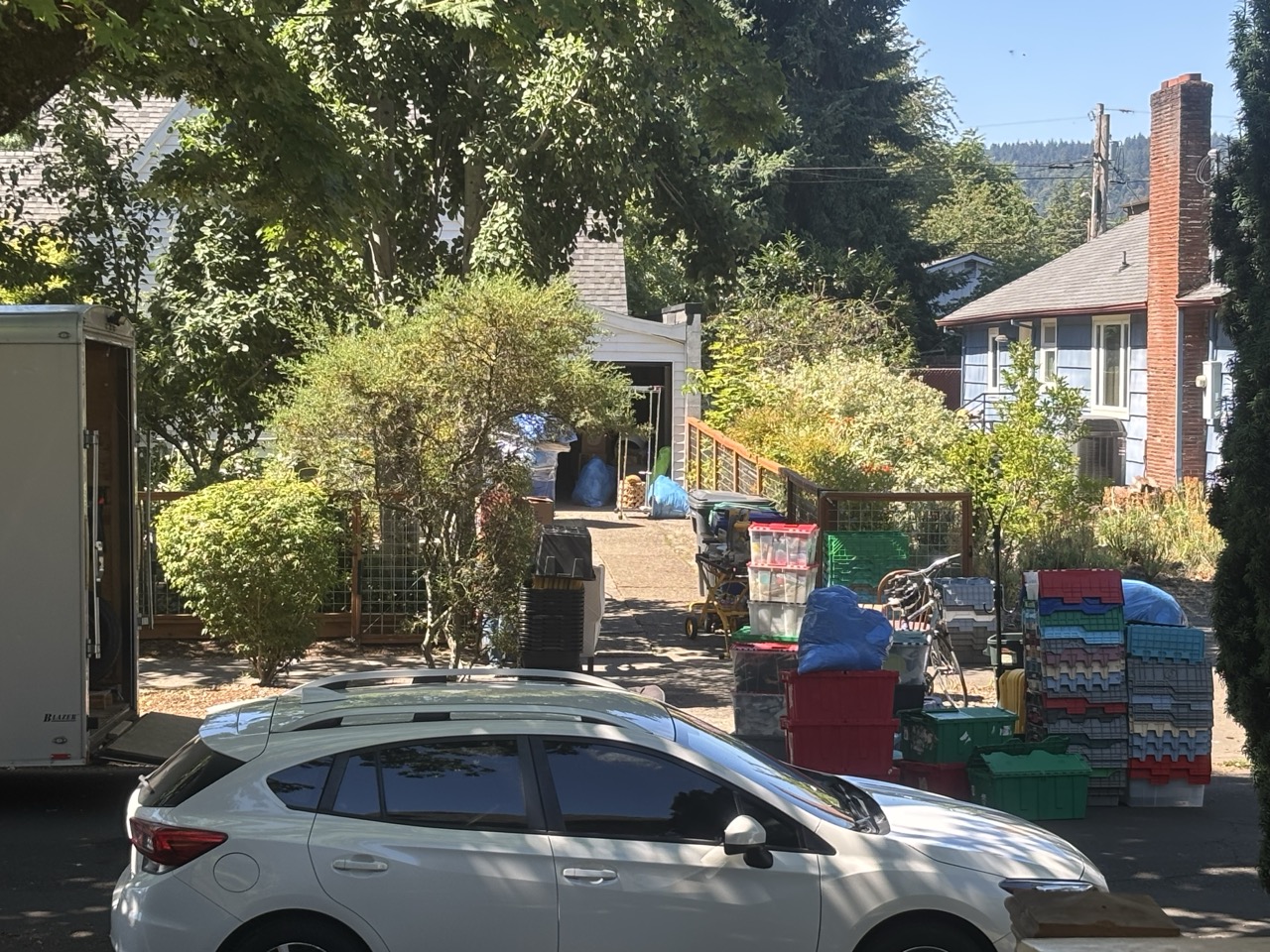
We weren't in the USA, when the cleanout happened. We were enjoying dinner in our Netherlands flat, when the crew arrived at the old house. I felt something like stability, like I had finally "let go", until my neighbor sent a picture of the carnage:


Yeah, it's gone. Thousands of dollars "invested" in clothes, technology, bicycles, luxury mattresses, mortgage payments for quirky estates. They were all temporary joys and conveniences. I didn't realize how quickly this truth would descend on me.

How many of these investments were "worth it"? If something had a lasting impact on my life, and made me a better person, or happier in the long term, then it's a win, yes? ... So, the honest answer is: not much. Definitely less than half.

This post is hard to write, because the whole affair still bothers me. I believed I could "let go" of my stuff and "reset" my life, and this was a necessary lie I told myself, to cope with the process of moving. It can't possibly be that easy, for anyone.

I took photographs and videos of a few things, to keep digital memories forever: a special quartz crystal, photo frames gifted from friends, a silly assemble-it-yourself plywood pinball machine, etc. I rediscovered forgotten objects that I once cared about (thanks, ADHD). Maybe it's easier to walk away from stuff if you have ADHD; your new obsessions will distract from the old psychic wounds? I hope so.

My original plan for the year 2025 was to exit my job around summer, then bum around Portland undoing the stacked stresses of the job: reconnecting with friends, and revisiting favorite hangouts. Then we'd move somewhere cheaper, in the USA; maybe Portland, maybe not, but I expected to take my time finding the right house, maybe a "forever home". This plan was concocted in 2024, when Vice President Harris absolutely destroyed the other guy in a live TV debate. So it seemed like the future was bright.

Things don't always go as planned, and everything surrounding you is temporary. I wish I had better advice to offer. Walking away from your life hurts. It was a messy exit; maybe it always is. I didn't reconnect with friends in the way I wanted. I miss my favorite restaurants, and fabric stores. You have to give yourself grace, and let your emotions run their course.

The good news is, you can look forward to new experiences on the other side. We just purchased e-bikes, and I pushed through my nervousness and pedalled around the city's proprietary bike lanes, for 30 whole minutes. It was awesome! We've been struggling this week, rebooting our lives in this barren townhouse, and we barely speak a word of Dutch. With the e-bikes, everything seems closer and more accessible. Also it's beautiful here, and the trees are full of wild parrots, so what can I say? Things will get better. Things will feel better, soon.

Letting go of your material life sucks. You're not alone in feeling this way. It's impossible to avoid this completely. That's really it.

When you're thinking about the pain, be sure to also consider the opportunities on the other side: New experiences. New favorite places. Maybe some old routines aren't benefiting you anymore; maybe you want to do better, or try something different.

My therapist once said that our brains tend to weigh negative emotions 2.5x stronger than positive ones. So for every reason to not move, see if you can counteract this by thinking of 2-and-a-half reasons to take the leap, and do it.

This post took days to write, because we're stressed and confused, and I rediscovered chardonnay. There's more to say on this topic (especially: what to bring! And, I mailed boxes from the USA to the Netherlands, which are currently stuck in customs, so I hope to have a happy follow-up post when they're cleared.) Stay tuned! ...
zka: (Default)
This question comes from [personal profile] garote: Why did we choose the Netherlands? How does one choose a destination, anyway?

Our answer is a long, rambling story. The vital bit isn't the destination itself, but rather the process of exploring what's possible, especially with constraints (time, age, abilities, giant dog). Keep in mind that we've felt a sense of urgency since the election, like we could become trapped unless we hurry. I wanted to leave quickly, but I also didn't want to "settle", or wait for the choice to be made for us. We discussed a dozen destinations; if Plan A didn't work out, then we'd fall back on Plan B, etc.

I admit that the Netherlands wasn't our initial choice. Our first impulse was to move to Canada.

Not Canada


Shortly after January's inaugeration, Canada seemed like the obvious choice, because it was logistically easy. "We can just drive there." We have a large, ill-tempered dog, and the ability to drive her to our destination was a huge advantage, compared to the expense and stress of shipping her via airplane. English is spoken there. My husband had prior experience living in the French-speaking parts, and he raved about it.

My primary care doctor also had a hot tip: Canada has fast(er) tracks to citizenship, for skilled professionals. In my line of work (software engineering) this is the "Federal Skilled Worker Program".

Also, unlike the USA, Canada doesn't consider visitors performing remote work for a foreign employer to be "work" that requires a work permit.

One downside of this program is that it's a lottery: you submit your application, and hope they draw your name to participate in the program. Another drawback is that you need to score enough points on a qualifying test. Briefly, there are 6 categories (but I haven't included all the point values):

  • Language test: 24 points.

  • Education.

  • Career (occupation, and years of experience).

  • Age (younger is better): max 12 points.

  • Working in Canada: do you have employment guaranteed before you arrive?

  • "Adaptability": extra points if your partner passes the language test, or if your partner worked in Canada previously with a valid work permit, etc. Max 10 points.


^^ Language: You can take the Canadian Language Benchmark (CLB) test at selected sites in the United States, and prepare by watching practice tests on YouTube. As a native American English speaker, I found the test to be surprisingly challenging. It includes tasks like: study a complex photograph for 15 seconds, then speak a fluent description of everything in the photograph, including breakdowns of what the people seem to be doing, and environmental cues. You have 45 seconds.

^^ Age: The max score is 12 points. Beyond age 47, you receive zero points. I guess that's the age when folks become a drain on the medical establishment? :(

As of 2025, the minimum qualifying score was 67 points. I could potentially qualify, just barely, if I snagged all 10 points for Adaptability. :( :( It seemed like a long shot.

Canada would have been easier, and more attractive, if I had a job lined up; a guarantee of employment. This is probably much easier than do-it-yourself immigration: Let your new employer handle the paperwork. Note that I did not have this opportunity, and by the time I started applying to jobs, I realized the tech job market was in dismal shape, compared to 2020. If other Americans are suddenly applying for positions, then you're competing against all of them; they're potentially younger (than me), and more attractive to prospective employers.

Also, Canada isn't immune to economic strife. There's an ongoing discussion about Canadians living in poverty; Vancouver has become unaffordable to many Canadians. Nowhere is perfect, but we started having second thoughts.

Not the U.K.


For the "big move", I wanted to aim high, and find somewhere prosperous and relatively stable, where we could enjoy life and thrive. One of my husband's top priorities was finding somewhere amicable to the LGBTQ community. I wanted to travel and explore (since I've hardly gone anywhere in 10 years). The most attractive destinations seemed to be Europe and the UK.

From January through April, I tried arranging an "international transfer" at my job (a large tech company, with offices around the globe). Also I applied for new positions at the international offices, and interviewed with a team in London.

I'm unable to share the reasons these maneuvers didn't work out, but the point is: they weren't interested in assisting with my international move. In the eyes of upper management, there was no business justification for it. If I had been chosen to (say) lead a fledgling team in Munich, then obviously they would have green-lit a move to Germany. Sadly, I was on my own.

The Netherlands


Even before we dreamt of Canada, I rediscovered this excellent talk about 'Residency Hacking' at Toorcamp 2024. May I recommend watching this video, and taking notes? (It's an hour long, so some level of focus and attention is required. Remember college lectures? Remember the days before smart phones, when you had a longer attention span than a goldfish??)

The speaker (T-Prophet) presents many paths to citizenship in other countries, and some tactics for living remotely longer than a few months. For example, there are nations that let you flat-out buy citizenship! Seriously, watch the video. Opportunities are everywhere, and they're constantly in flux; I wouldn't be surprised if other countries provided special immigration paths for Americans soon. (... :( ...)

T-Prophet describes one interesting possibility: The Netherlands and the USA made a pact in the 1950's, called the Dutch-American Friendship Treaty ("DAFT"). After World War II, the Dutch people wanted to rebuild and strengthen their economy. This is a stereotype, and probably not why the pact was created, but: Since Americans are good businessmen, why not import them as entrepreneurs??! It sounds insane by today's standards, but as T-Prophet points out, once a government institution like DAFT is established, it tends to stick around forever. This sounded like a promising lead.

In January, I reconnected with former clients, and inquired if they were still hiring contractors (i.e. me); some were interested! Before my 5-year gig at the big tech company, I was self-employed for 12 years. I don't consider myself a "good" businessman, but I survived, and I imagine I can do it again.

My husband lived in Amsterdam in his 20's, and loved the experience. So we felt excited about this possibility.

We contacted 3 immigration attorneys in the Netherlands, and scheduled virtual consultations (due to the time zone difference, these were always early in the morning; late afternoons for them). They were booked weeks in advance (again, what is happening to America? Are people trying to leave in droves, or something??) so we had to wait a bit. But we liked the first attorney, so we agreed to engage with her, and cancelled the other meetings.

I am not a lawyer, so the following information should not be regarded as legal advice. You'll want to hire an attorney to clarify these points, and ensure you're fulfilling all the requirements of DAFT, for yourself. But this is a general overview of how it's worked, so far:

  • Secure a residence address, in the Netherlands. We used a property hunter, who specifically works with expat's. After signing the lease (virtually), we flew to the Netherlands and picked up the keys to our rental. (If you have cool Dutch friends, maybe they'll let you use their address, to receive mail etc; this is valid too. Temporary residences like AirBnB's are not allowed, apparently they do check this.)

  • Open a Dutch bank account. There's a virtual bank (Bunq) which doesn't require Dutch ID, for the first 90 days!

  • Dutch ID: Our attorney set up critical appointments for getting the Residence Endorsement Sticker, Biometrics, and Town Hall Registration. (Our first appointment was today.)

  • When I have a Dutch ID number, I can create a business entity in the Netherlands. This will likely be a B.V. (similar to an American LLC). This comes with some perks: you can exchange your American driver's licence for a Dutch one, without taking the driver's test. There are some tax advantages. Etc. The financial requirements may be stricter, I have a consultation with a tax professional tomorrow; if the B.V. isn't possible, then the other option is a sole proprietorship (aka "eenmanszak").

  • DAFT requires a business bank account to exist, with a minimum balance at all times (4,500 euros). This will be audited annually. Never touch this money.

  • DAFT also requires you to have 2 (or more) clients annually. If you only have 1 client, then you're effectively an employee of that client; you can be kicked out of the DAFT program, and you'll need to shift to a different track to citizenship. If a company loves you, and wants to hire you, they can sponsor you for an employment visa.

  • You must live in the Netherlands for 183 days per year (half the year).

  • Your partner will receive a regular Dutch working visa, and can apply for jobs.

  • You become a permanent resident after 5 years if you learn the Dutch language. Don't ask me how they test for this; I'm nowhere near ready!


Don't "Settle"


Initial impressions of the Netherlands: I appreciate how the Dutch people are direct, without overusing formalities. I love all the bicycling. Groceries are delicious, and taste healthier than the USA. It is expensive, and the housing market is competitive. The Dutch people love their dogs (but will they love our 65-pound barking poodle?? To be determined.)

From a purely selfish angle, I've fantasized about living abroad (especially in Europe) since my 20's, yet I never tried to make this a reality. I'm excited to finally close this mental loop, and thrilled that we're adjacent to friggin' Amsterdam, in Europe of all places. This is the riskiest endeavor of my life, and we're experiencing culture shock on an hourly basis, in an expensive part of the world. I'm still optimistic about our future here.

Since January, we've felt the need to hurry up and leave the USA, so that's why we investigated so many possible destinations. I'm glad we found a place to love, and in the long-run I think I'll appreciate not moving somewhere just to work a new desk job, with a high level of stress and frustration.

This is our sixth day, and this afternoon we were granted permanent resident visas for 2 years. This is big news!! The immigration official said that we were approved so rapidly because we used an immigration attorney.

What other topics should I rant about ?? Lemme know. Big list of ideas:

  • Plans for the next year, and beyond.

  • Shipping a live animal overseas.

  • Saying goodbye to your precious belongings, and illusions of security.

  • What you actually need to bring: medical records, etc.

  • My embarrassing attempts at learning the Dutch language, and assimilating to their way of life.
zka: (Default)
My husband, myself, and our 4-year-old poodle have safely relocated from the USA to the Netherlands.

I promised to detail aspects of our journey, for those curious about moving themselves: How does the process work? What is required? I hope to have enough time and energy to write more posts on this topic, because I feel it's important, and in fact urgent for many of us tagged as minorities (e.g.: you're not heterosexual, or you're not white, or you believe in the scientific method, etc).

This post is about something called the Apostille Stamp (pronounced: "app-uh-STEEL").

If you're American by birth, you possess a birth certificate. If you're married, you also possess a marriage certificate. These are important documents, yes? They prove your date of birth, and who you're legally married to. You need these documents to register for citizenship in foreign countries, and do other citizen magic: acquire insurance, get a driver's license, prepare a legally-binding will, etc.

However! By default, these American certificates are not recognized in other countries. Your default birth cerficate effectively does not prove your identity; your marriage is not valid outside of the USA. This applies even to the original documents; they are as useless as a copy of the original would be.

The only way to validate these certificates for other countries, is to get something called an Apostille Stamp. Scroll down to the list of Contracting States: If any of these 127 countries sound like desirable long-term destinations, then you'll want to get the Apostille Stamp on your certificates. The stamp instantly makes your certificates valid in every other country on this crazy-long list. You can just show the stamped document to government officials there, and they'll say "okay", and you're golden.

Let me say this up front: Given how the United States federal government is being dismantled from inside-out, and how multitudes of people are scrambling to exit the USA, I recommend getting your documents stamped with the Apostille as soon as possible. In this post, I'll repeat this idea several times, because if you're entertaining the idea of moving to another country, and you're thinking you can "wait" and "see what happens" regarding the paperwork, you will run out of time.

Stop lying to yourself with phrases like, "I'm sure things will work themselves out."

Certified Birth Certificate


You will need a certified birth certificate to get the stamp. Is your birth certificate certified? If you don't know, then the answer is most likely: no, it is not.

In my case, I mailed my birth certificate to get the apostille stamp, only to learn that the certificate itself was uncertified, "too old", and the original recorder's signature wasn't "in the system". This was expensive (I paid for overnight delivery and return), but also a big waste of time. You can fix all these problems by obtaining a certified birth certificate:

Contact the Recorder's Office, in the county where you were born. In my case, this was Santa Cruz County, California. (The phone number on the Recorder's website always dumped me into voicemail, with no callbacks. After calling other numbers at the same building, someone picked up and transferred me to a friendly human at the Recorder's Office. Be persistent!)

The Recorder's Office should have a copy of your birth certificate on file. In my case, they were able to confirm this over the phone. Each state has different fees when ordering certified copies, but it wasn't too expensive (mine was around $45 for 2 copies). As it turns out, the Santa Cruz Recorder's Office doesn't deal with orders directly, they use third-party vendors to manage the orders and shipping.

Allow me to kindly-but-firmly recommend that you order two certified copies of your birth certificate, maybe more. There may be times when you'll send one copy off for processing somewhere, and you'll want to possess a spare.

More importantly, each state has different processing times. The third-party vendor in Santa Cruz was fast (a few days), other states may be slower.

Yes, if they offer expedited shipping, you should absolutely pay for it. Jump to the head of the queue, whenever possible.

Seriously, if you don't have certified copies of your birth certificate, order these now. Only a certified copy can receive the apostille stamp.

Apostille Stamp


Documents can only be stamped with an apostille in the state where they were issued. This typically happens at the state capitol, in the Secretary of State Notary's office.

Normally you would mail your certificate(s) to the Notary's office, and include payment, and pre-paid postage so the completed documents can be mailed back to you.

You can also achieve same-day processing if you show up in person. We drove our marriage and birth certificates to Oregon's capitol (Salem). They successfully stamped the marriage certificate (we were married in Portland), but informed us that our birth certificates needed to be stamped by our birth states: California (me) and South Carolina (husband).

Since I wasted time with a non-certified birth certificate which was "too old", I didn't have sufficient days left to await processing by mail to-and-from the capitol of Calfornia, Sacramento. Originally the website for the Sacramento Notary's Office claimed the processing time by mail was 3 days. By the time I had a certified birth certificate in hand, that estimate had increased to 5 days. (Hmm, are many other Americans suddenly lining up to use this service?)

I ended up booking a same-day flight from Portland to Sacramento, just to get my two birth certificates stamped with the apostille. This ended up being a nice day trip, but at the expense of a good night's sleep from the early flight, missing a full day of potential packing, and nearly $1,000 for the airfare. :(

Don't be like me, and don't delay until the last minute, especially if processing times are creeping ever-longer: get the apostille stamp now.

The apostille itself isn't too exciting: it's a metallic seal, and an extra piece of paper stapled to the original document, and a stamp spanning both papers. Tearing the pages apart renders the apostille invalid.

But Why Should I Lift a Finger


I know, this stuff is really inconvenient, and it costs money. Even worse, you may have to do some web-research, and find ways to contact government offices, and crap like that. Wouldn't you rather spiral in a vortex of ADHD doom-scrolling? Or numb yourself with Assassin's Creed, or whatever the kids are playing now?

I strongly encourage anyone who's remotely interested in exiting the USA to take this seriously. Please, stop what you're doing, and get certified birth certificates, with apostille stamps. Government services like Recorder's Offices and Notaries should be considered at-risk at this moment in time, and are likely already understaffed. As the power structure of the federal government lurches towards dictatorship, these services could be stripped away entirely, without warning.

I'm not a refugee, but I imagine it's much easier to find another home with an apostille stamp, than to be suddenly relocated as a refugee due to a fascist takeover.

Seriously, get certified birth certificates. Get apostille stamps. These documents are required for citizenship, in 126 other excellent countries as of 2025. Ignore this advice at your own peril.

If we had known this information, and acted sooner, then we could have saved much grief and stress, especially in the harrowing days leading up to our final flight out of the USA.

Do you want more posts about exiting the USA? Let me know what topics I should rant about.

Profile

zka: (Default)
zka

January 2026

S M T W T F S
    123
45678910
11121314151617
18 192021222324
252627282930 31

Syndicate

RSS Atom

Most Popular Tags

Style Credit

Expand Cut Tags

No cut tags
Page generated Feb. 8th, 2026 10:00 am
Powered by Dreamwidth Studios